Short answer. While both belong to the Lamiaceae family and are traditionally brewed across the Balkans as mountain tea (çaj mali), Sideritis scardica thrives on higher subalpine limestone screes (typically above 1,000–1,200m) in the Vjosa basin, resulting in higher concentrations of phenylpropanoids (verbascoside) and kaurene diterpenes due to intense UV-B radiation. Sideritis syriaca adapts to slightly lower Mediterranean elevations with distinct monoterpene ratios dominated by pinene and carvacrol.
Morphological Differences and Habitat Altitudes
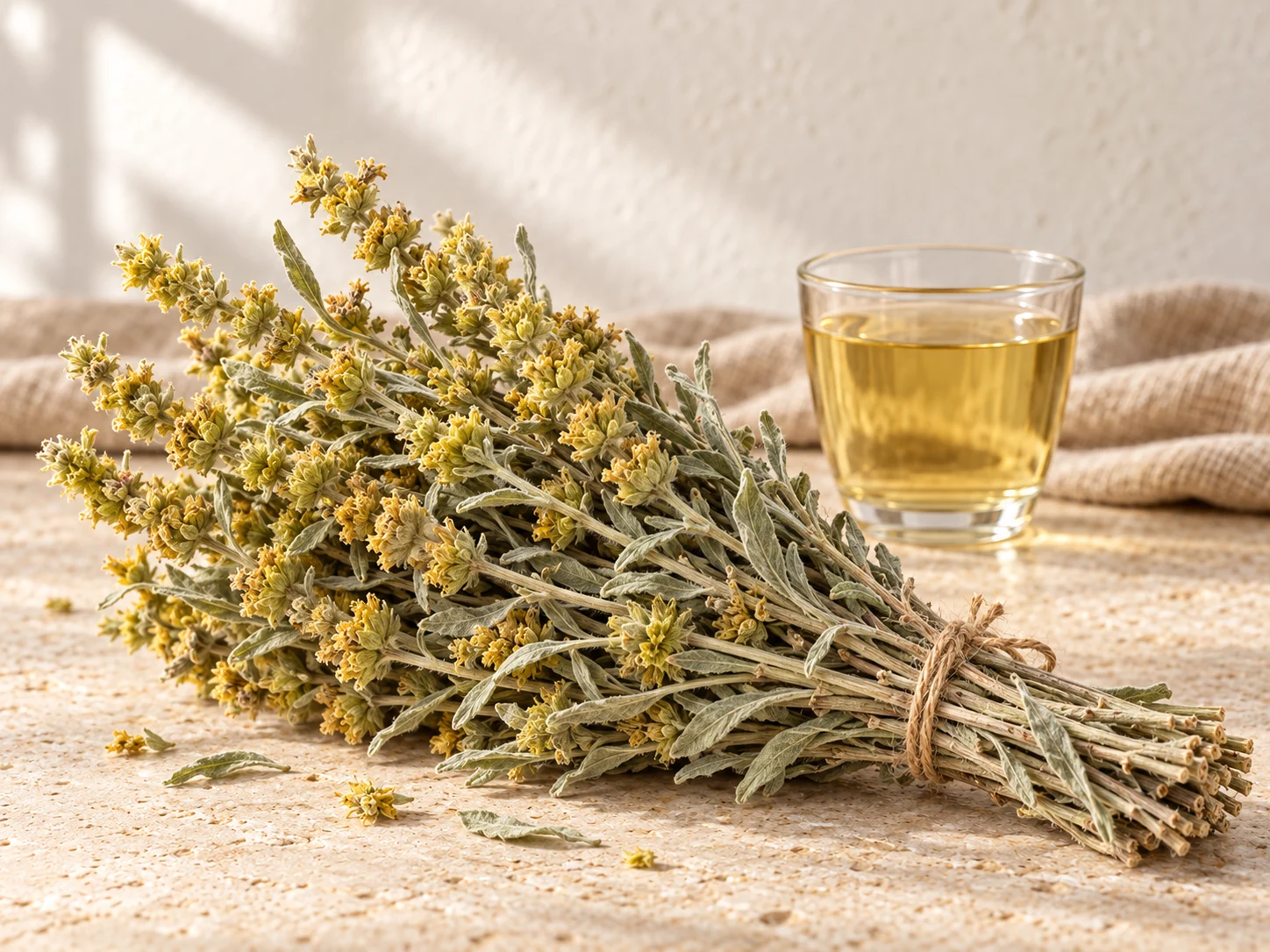
Sideritis scardica (often known in Albania as Çaj Mali Shqiptar) is distinguished by compact, dense inflorescences wrapped in broad, chartreuse bracts covered in thick woolly hairs (trichomes). These trichomes insulate the plant from freezing subalpine night temperatures and reduce leaf transpiration.
In contrast, Sideritis syriaca exhibits elongated flowering spikes with slightly smaller bracts. S. scardica colonizes sheer limestone crags across the southern Albanian mountains of Trebeshinë, Dhëmbel, and Nemërçkë at elevations between 1,000 and 1,800 meters.
Comparative Phytochemistry and Terpene Density
Phytochemical profiling reveals that both species are rich in apigenin, luteolin, and verbascoside. However, high-altitude Sideritis scardica consistently displays higher total phenolic content per dry gram, driven by severe solar stress and sparse karst soil.
Clinical trials on human cognition and cerebrovascular perfusion have specifically tested standardized Sideritis scardica extracts (Wightman et al., Nutrients 2018;10(8):955), demonstrating acute increases in prefrontal cerebral blood flow and reductions in cognitive anxiety.
Traditional Harvesting and Table Brewing
In the Vjosa Valley, foragers cut only flowering stems with scissors, leaving root crowns intact. When preparing at home, simmer whole stems in cold mountain spring water for three minutes to release both water-soluble flavones and delicate aroma terpenes.
- Elevation: S. scardica grows at 1,000–1,800m; S. syriaca typically at 800–1,400m.
- Key Compounds: Dense verbascoside, apigenin 7-O-glucosides, and kaurene diterpenes.
- Human Evidence: Standardized S. scardica extract evaluated in double-blind trials (Wightman 2018).
- Ritual Brewing: Gentle 3-minute cold-start simmer preserves essential volatile oils.