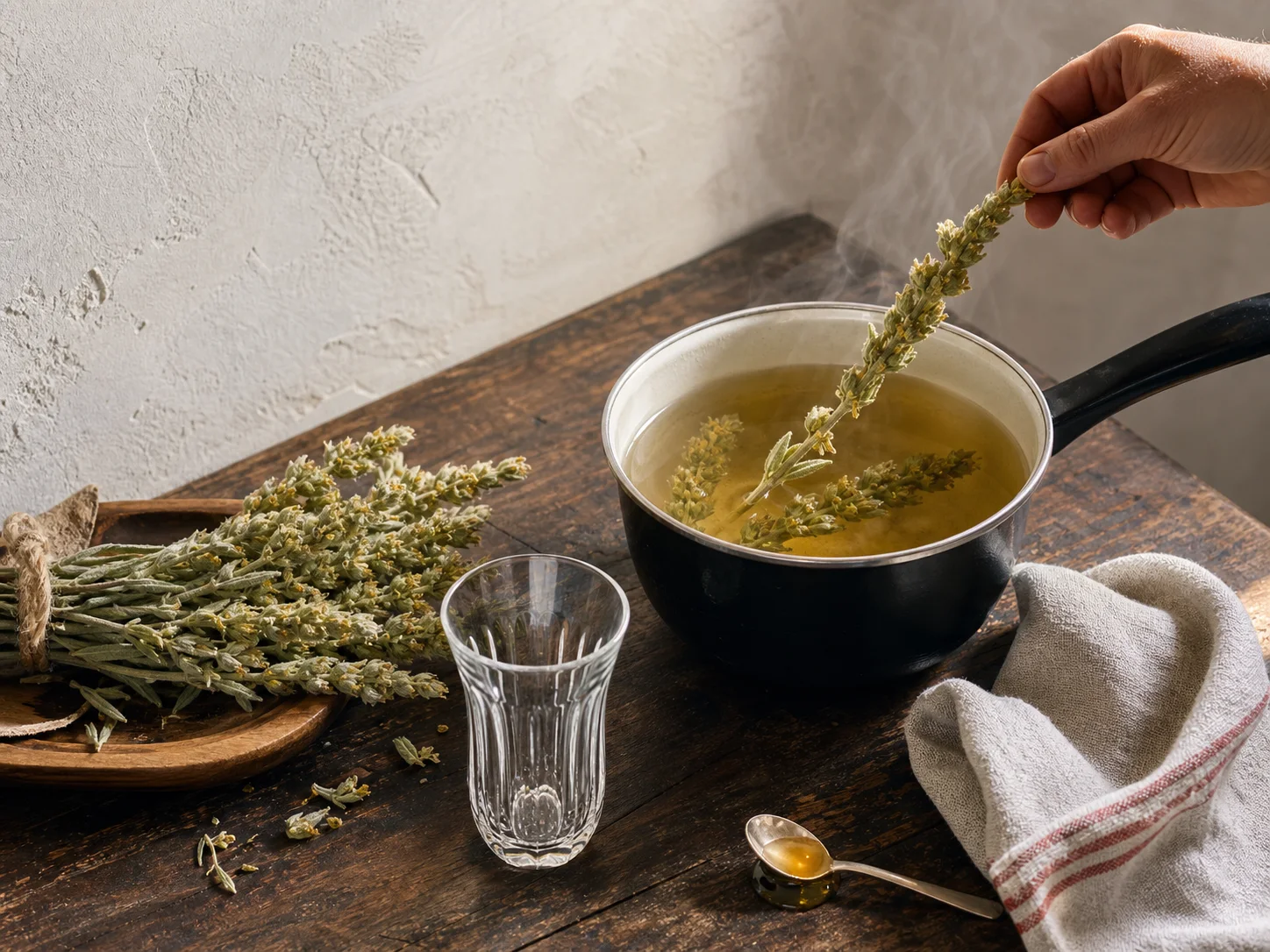
Short answer. Unlike delicate tender tea leaves (Camellia sinensis) which are infused by pouring boiling water over an open basket, whole mountain tea (*Sideritis*) consists of fibrous, lignin-rich stems and dense flowering whorls. Optimal phytochemical extraction requires a traditional gentle decoction: starting unbroken stems in cold spring water, heating gradually to a boil, and simmering covered for precisely 3 minutes. This breaks open woody cell walls to release heavy verbascoside polyphenols while the closed lid condenses volatile aroma terpenes back into the broth.
Cell Wall Lignin and Thermal Penetration
The aerial stems of *Sideritis scardica* are reinforced with lignin and structural cellulose to withstand subalpine alpine winds. Merely pouring hot water over an intact stem fails to achieve sufficient thermal penetration, leaving over 60% of water-soluble polyphenols trapped inside unruptured plant cells.
A gradual cold-water start allows water molecules to penetrate the vascular cambium before boiling temperatures are reached.
Condensation of Volatile Pinene and Terpenes
The characteristic pine-floral aroma of mountain tea is driven by volatile monoterpenes (alpha-pinene, beta-pinene, 1,8-cineole) with boiling points between 150°C and 180°C that evaporate rapidly in steam. Simmering with a tight-fitting lid creates a micro-reflux cycle, condensing volatile aromatic fractions back into the tea broth rather than losing them to the room.
The 3-Minute Rule and Rest Period
After three minutes of quiet simmer, removing the pot from heat and letting it rest for two minutes achieves full amber extraction without extracting astringent tannins. Discover our Not-for-Sale Mountain Tea.
- Cold-Water Start: Enables osmotic hydration of fibrous woody stems before boiling.
- 3-Minute Simmer: Ruptures lignified cell walls to release verbascoside and flavones.
- Lid Reflux: Condenses volatile pinene and cineole aroma vapors back into the cup.
- Zero Bitterness: Pure Sideritis contains no caffeine and low astringent tannins.